There was a season when I worked in the corporate world, managing creative projects for a global brand. My role meant coordinating with counterparts in three different regions, and before our shared agency could move forward on anything, all three of us had to review the creative and sign off. Simple enough — except every region had its own layers of approvals, and the delays started piling up. Projects fell behind. Deadlines loomed. And I spent my days venting about it with our agency, all of us equally frustrated.
Here’s what I didn’t notice at the time: the more I complained, the more I became a magnet for everyone else’s complaints too. Someone would bring up a delay, I’d pile on with my own, and we’d burn fifteen minutes rehashing everything that wasn’t working. And afterward? Nothing had changed. The approvals didn’t come any faster. The processes didn’t get any simpler. The only thing that had shifted was my own state of mind — I was letting circumstances completely outside my control dictate how I felt, how I thought, and how I showed up.
Then something clicked. I couldn’t control how another region operated or how fast someone answered an email — but I could absolutely control my response. I could aim my attention at the work that was actually mine, bring solutions instead of complaints, and stop letting someone else’s process determine my peace. And here’s the wild part: the circumstances didn’t change. There were still delays, still approvals to wait on. But they stopped carrying the same emotional weight. I didn’t need the situation to change before I could change my mindset.
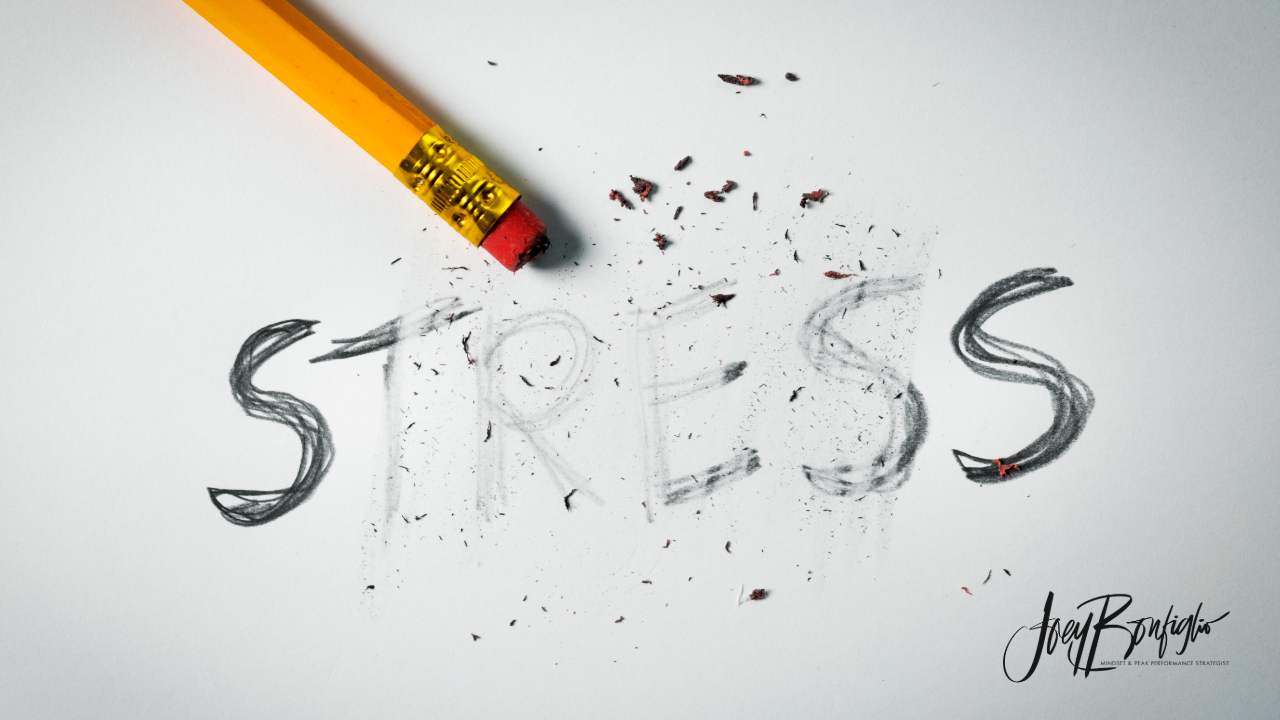
That season taught me something that reaches far beyond the corporate world: stress usually isn’t something you can eliminate from your environment — but you can absolutely become more intentional about how much attention, emotion, and energy you give it. The pressure was never really the problem. My response to it was. And if stress is mostly a response, that means it’s trainable — you can learn to carry it differently, stay steady when everything says panic, and choose calm on purpose.
Here are 5 ways to start.
1. Control what you can. Release what you can’t. This is the one that rescued me in that corporate season, and it’s the foundation of all the others. So much of our stress comes from gripping things that were never in our hands to begin with — other people’s choices, the timeline, the process, the outcome. That grip is exhausting, and it changes nothing. Draw the line: pour your energy into your actions, your effort, and your response, and release everything on the other side of it. You can’t carry the whole world. You were never supposed to.
2. Breathe on purpose. It sounds almost too simple, but your breath is the fastest remote control you have for your own nervous system. When stress spikes, your breathing goes shallow and your body floors the panic pedal — but the reverse works too. A few slow, deliberate breaths literally signal your body that the threat has passed and it’s safe to stand down. Before you react to the stressful thing, take three slow breaths. You’d be amazed how often that tiny pause is the difference between reacting and responding.
3. Get it out of your head and onto paper. Stress thrives in the swirl. When every worry, task, and what-if is spinning loose in your mind at once, it all feels enormous and tangled and impossible. So empty it. Write down everything that’s weighing on you — a brain dump, no filter, no order. Getting it out of your head and onto a page shrinks it down to its actual size, and nine times out of ten you’ll realize it was never as overwhelming as it felt. You can’t organize a mess you can’t see.
4. Simplify to the next right thing. Overwhelm is almost always the result of looking at everything at once. The whole mountain, the entire list, every problem stacked on top of each other — of course that’s crushing. The way out is to stop staring at all of it and ask one question: what’s the next right thing? Just the next step. Do that one, then ask again. Stress feeds on “everything, all at once.” Calm is built one single, doable action at a time.
5. Build calm before you need it. Here’s the one most people miss: don’t wait until you’re drowning to think about managing stress. The goal is to build daily habits that keep your baseline low — the movement, the rest, the quiet morning minutes, the prayer, the margin in your schedule that you stop trading away. When calm is something you practice every day, it’s there waiting for you on the hard days. You don’t rise to the level of your stress; you fall back on the level of your habits.
The common thread
Read those back and here’s what connects every one: calm is a skill, not a circumstance. It’s not something that shows up only when life finally settles down — because let’s be honest, life never fully settles down. There will always be delays, pressures, and processes you wish were different. The breakthrough is almost never found in getting all of that to change. It’s found in changing your relationship with it — in stopping the slow bleed of energy toward everything you can’t control and taking ownership of the one thing you always can: yourself.
There’s an old encouragement I come back to constantly — the invitation to be anxious for nothing, to hand your worries over, and to receive a peace that doesn’t even make logical sense given what you’re facing. I’ve felt that peace in the middle of some genuinely hard seasons, and I can tell you it’s real. Stress will always knock. But you get to decide whether you answer in panic or in peace.
🎯 Practical Tip
Build yourself a 60-second stress reset and use it the next time the pressure spikes: (1) pause and take three slow breaths, (2) name what you can actually control here and mentally release the rest, and (3) pick the one next right thing and do only that. Three steps, one minute. And to lower your baseline over time, pick one daily calm habit — a short walk, five quiet minutes before the house wakes up, a nightly brain dump — and protect it like it matters, because it does. Don’t wait for the storm to practice the peace.
Stress is a response you can train. Choose calm.
Obsessed with your goals and vision,
Joey Bonfiglio
Mindset & Peak Performance Strategist / 📩 The Weekly Mindset! 🚀
—
P.S. Learning to stay calm and steady under pressure is a core part of the Level Up Mindset System — building the daily habits that keep your baseline low and your peace protected. The Masterclass walks you through it: joeybonfiglio.com/masterclass. The book lays out the whole framework, step by step (joeybonfiglio.com/the-book) — and the free Level Up Tracker makes your calm habits easy to keep (joeybonfiglio.com/level-up).
RiZe. Grind. Repeat.